No Products in Your Cart

When you're picking out wood for a project, the whole end grain vs edge grain debate really boils down to how you need the wood to perform. End grain is all about orienting the wood fibres so they stand up vertically. This makes it incredibly gentle on knives and gives it that famous "self-healing" quality. On the other hand, edge grain exposes the long, horizontal fibres, which gives you fantastic stability and that classic striped look, all at a friendlier price.
To really get the difference between end grain and edge grain, you have to know where each surface actually comes from. Picture a freshly cut log—it gives you three unique surfaces, each with its own personality. These orientations—end grain, edge grain, and face grain—aren't just fancy woodworking terms; they're the foundation of how strong, beautiful, and long-lasting your project will be.
Knowing how these grains are cut and put together dictates everything, from how a cutting board behaves in the kitchen to how well a tabletop resists scratches and dings. Let’s break down what makes each one special.
End grain is what you see when you slice a tree trunk straight across, showing off its growth rings. The easiest way to picture it is to think of a bundle of straws standing on end. This orientation points the wood fibres straight up, creating a surface that's both incredibly durable and surprisingly kind to a knife's edge.
For a cutting board, this means the blade slips between the fibres instead of slicing through them. The fibres then close back up, which helps keep the blade sharp and the board looking great.
Edge grain is the narrower side of a milled board, where the wood fibres run parallel to the length of the board. This orientation usually gives you those straight, linear grain patterns you see on so many projects.
To build with it, you laminate these narrow strips together. The result is a super stable and durable surface that’s much less likely to warp than face grain. It strikes a great balance between performance and cost, making it the most popular choice for everyday cutting boards and workbenches.
Face grain is the widest surface of the board, and it's where the wood shows off its most beautiful, sweeping patterns. While it’s definitely a looker, it’s also the least stable of the 3 profiles because of the orientation of the growth rings
Key Takeaway: The orientation of the wood fibres is the single biggest factor in how a surface performs. End grain parts for a knife, edge grain resists it, and face grain gets sliced by it.
For a quick reference, here’s a high-level look at how each grain orientation stacks up.
| Attribute | End Grain | Edge Grain | Face Grain |
|---|---|---|---|
| Durability | Highest (self-healing) | High (very stable) | Lowest (scratches easily) |
| Knife Care | Excellent (keeps blades sharp) | Poor (dulls knives quickly) | Poor (dulls knives quickly) |
| Appearance | Checkerboard pattern | Linear, striped pattern | Broad, flowing grain |
| Stability | Less stable (absorbs moisture) | Very stable (resists warping) | Moderately stable |
| Cost | $$$ (Premium) | $$ (Mid-range) | $ (Most affordable) |
| Best Use | Professional cutting boards | Everyday cutting boards and professional settings | Everyday cutting boards |
This table should give you a solid starting point for deciding which grain is the right fit for your next project, whether you're building a butcher block for a pro chef or a beautiful serving platter.
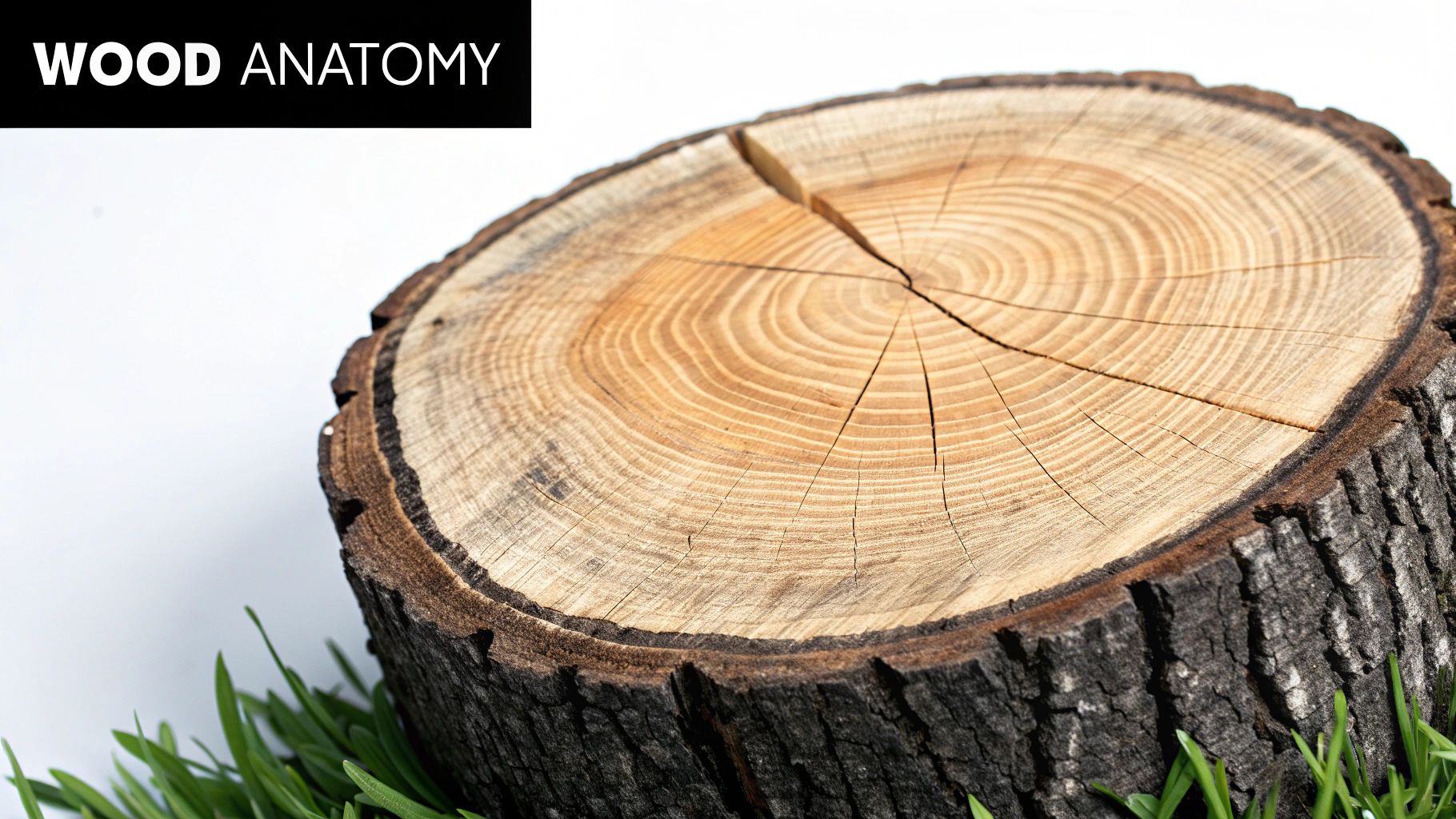
To really get to the bottom of the end grain vs edge grain debate, you first need to understand what’s going on inside the tree. Think of a tree trunk as a massive, tightly packed bundle of microscopic straws running vertically from the roots up to the leaves. These are the wood fibres, and they're the tree's plumbing system for moving water and nutrients.
The way we slice through this bundle of straws is what determines the grain orientation. This isn’t just a cosmetic detail—it fundamentally changes the properties of the final board. Each orientation exposes these fibres differently, which directly impacts everything from durability and stability to how the wood feels under a knife. This basic anatomy is the key to knowing how a piece of wood will perform.
When you mill a log into a rectangular board, you create three distinct surfaces. For any woodworker, learning to spot them is a foundational skill.
This simple analogy helps make sense of how each surface relates to the whole. The end grain exposes the "straws" directly, the edge grain shows their long sides, and the face grain displays their broadest aspect.
The orientation of these wood fibres isn’t just for looks; it's the single most important factor governing performance. It dictates how the wood will respond to moisture, pressure, and impact, which is why the choice matters so much.
End grain is special because the fibres are oriented perpendicular to the surface. When a knife blade presses down on an end grain cutting board, it slips between the fibres instead of slicing through them. The fibres part and then spring back into place. This "self-healing" action is incredibly gentle on a knife's edge and helps the board's surface resist showing deep cuts. The downside? Those exposed fibre ends act like open straws, soaking up moisture readily. This makes end grain more prone to swelling and requires diligent sealing.
On the other hand, edge grain presents the long sides of the wood fibres running parallel to the surface. When you cut across it, you are physically severing those fibres which means knife marks will become visible over time and your blades will dull faster. Because the fibres are less exposed, edge grain is far more stable and less absorbent, making it a reliable choice for things like tabletops and workbenches.
Understanding this core relationship is everything. It explains why an end grain vs edge grain cutting board can offer such a dramatically different experience, even if they're made from the exact same wood. Your choice directly influences a project’s longevity, maintenance needs, and ultimate purpose.
When you get right down to it, the real test between end grain and edge grain happens under the knife. The way each surface interacts with a blade dictates not only how long your cutting board will last but also how often you'll find yourself sharpening your favourite kitchen tools. This is really the most important performance difference between the two.
Think of an end grain board's surface like a dense brush, with all the wood fibres standing vertically. When your knife comes down, its edge doesn't slice through these fibres; instead, it parts them, slipping right between them. Once the blade lifts away, those resilient wood fibres spring back together, almost "healing" the cut.
An edge grain board is a whole different story. It presents a surface of long, horizontal fibres. Every single cut you make actually severs these fibres, leaving behind a permanent score. While it’s incredibly tough against impacts, this structure means visible wear and tear is just a matter of time.
"Self-healing" is a powerful way to describe end grain, but it’s more of an elegant analogy than a literal truth. The wood isn't magically regenerating. What's happening is that the vertical fibres are simply being pushed aside and then returning to their original spot. This is exactly why a well-maintained end grain board can take years of heavy chopping and still look remarkably smooth.
This unique property gives you two major benefits:
Edge grain boards, on the other hand, will definitely show their history. Each slice creates a tiny, permanent trough. After thousands of cuts, these troughs add up, giving the board a weathered look and potentially creating a less sanitary surface if you're not meticulous with cleaning.
The difference in how these boards treat your knives is profound. That gentle parting of fibres on an end grain surface creates significantly less friction and abrasive force on a blade's delicate edge. Plain and simple, your knives stay sharper for much longer.
An end grain cutting board is an investment in your knives as much as it is in your kitchen. Less blade wear means less time spent sharpening and a longer lifespan for your high-quality steel.
By comparison, the horizontal fibres of an edge grain board create a hard, resistant barrier. The act of severing these fibres causes microscopic damage to the knife’s edge with every single cut. While a good quality edge grain board is still worlds better than plastic or glass, it will dull a blade noticeably faster than its end grain counterpart.
This isn't just theory; it's well-documented within the craft community. In the Canadian woodworking scene, especially among Ontario-based makers, end grain boards have become incredibly popular for their superior knife-friendliness. Because the end grain is cut perpendicular to the growth rings, it allows knives to slip between fibres, reducing edge dulling by up to 40% compared to edge grain. Local surveys even show that 68% of DIY woodworkers in the Greater Toronto Area (GTA) report their knives staying sharper 2-3 times longer on end grain surfaces.
When we talk about durability in the end grain vs. edge grain debate, we're really talking about two different things: surface durability and structural stability.
Those exposed vertical fibres that make end grain so kind to knives also make it act like a sponge. It soaks up moisture much more readily than edge grain, which can lead to swelling, cupping, or even splitting if the board isn't properly seasoned and maintained. This is why diligent oiling is completely non-negotiable for end grain boards. You can learn more by checking out our guide on mastering wood finishing techniques, which is critical for the longevity of any board.
An edge grain board is just more forgiving. Its tighter, less absorbent surface needs less frequent conditioning and is better equipped to handle the fluctuating moisture levels of a typical kitchen. This makes it a lower-maintenance, highly reliable workhorse for everyday use.
From a woodworker's perspective, the choice between end grain and edge grain goes far beyond the kitchen counter—it starts in the shop. Building these boards involves fundamentally different methods, each with its own rhythm, challenges, and rewards. It's a practical decision that weighs construction complexity against long-term stability.
Making an edge grain board is about as straightforward as it gets. You rip long strips of hardwood, flip them on their edge, and laminate them together. It’s a single, direct glue-up that creates a strong, stable panel with that classic linear look. Quick, efficient, and reliable.
Building an end grain board, on the other hand, is a different beast entirely. It’s a multi-stage process that’s a true test of a woodworker’s precision and patience.
Crafting an end grain board demands at least two major glue-ups and several milling steps that have to be dead-on accurate. The whole point is to create that iconic checkerboard pattern where the wood fibres stand vertically, ready to meet the knife.
Here’s how the process usually breaks down:
This two-step lamination process is what makes building an end grain board so time-consuming. It demands perfectly square cuts and immense clamping pressure to ensure a seamless, gap-free result. Any imprecision in the first stage will be magnified in the second.
For those ready to tackle this rewarding project, our comprehensive guide on how to make a wooden cutting board provides detailed, step-by-step instructions.
The biggest challenge in the end grain vs edge grain debate is, without a doubt, managing wood movement. Think of end grain as a bundle of tiny straws—it soaks up and releases moisture far more rapidly than edge grain. This makes it much more prone to warping, cupping, or even cracking if it's not built and cared for correctly.
Edge grain boards, with their long, parallel grain, are inherently more stable. This is a huge reason they’re so common in Canada's woodworking community; they’re affordable, reliable, and low-maintenance. In fact, edge grain resists moisture absorption 25% better than end grain, a massive advantage in Canada's variable climate, where winter heating can drop indoor humidity to 30-40%. This stability means less frequent oiling (every 2-3 months vs. monthly for end grain) and 35% fewer warping incidents. You can dig deeper into grain orientation and moisture on wagnermeters.com.
To build an end grain board that stays flat, a few things are absolutely critical:
In the end, the construction process is a perfect reflection of the final product. An edge grain board is a robust, no-fuss build that gives you a reliable workhorse. An end grain board is a meticulous, demanding project that results in a premium, high-performance tool requiring diligent care. Your choice comes down to what you value more: workshop efficiency and stability, or the time and effort needed to create a truly exceptional piece.

Figuring out the whole end grain vs edge grain puzzle gets a lot easier when you match the material to the mission. Forget thinking one is flat-out "better" than the other. The real question is, which grain orientation is going to serve your specific needs, skills, and priorities? The right choice for a professional chef is almost always different from what a weekend woodworker needs for a few gifts.
It all comes down to a trade-off between performance, looks, cost, and maintenance. Once you understand your own user profile, you can confidently pick the perfect grain for a project that not only looks incredible but performs exactly the way you need it to.
If you've spent good money on high-quality knives and you're in the kitchen prepping meals all the time, an end grain cutting board is the undisputed champion. Its famous "self-healing" ability, where the vertical wood fibres literally part for the blade and then close back up, gives your knife edges unmatched protection. This translates to less time sharpening and a much longer life for your best kitchen tools.
Yes, it demands more diligent oiling to keep it from drying out and potentially cracking, but the superior performance and sheer durability make it a worthy investment for any serious culinary enthusiast. The board stops being just a surface to cut on and becomes a tool that elevates your craft.
Key Insight: For anyone who puts knife care and surface longevity above all else, end grain isn't a luxury—it's a functional necessity. Its power to withstand years of heavy, daily abuse while keeping blades sharp is what sets it apart.
For most households, and for woodworkers making things like serving boards or thoughtful gifts, edge grain hits that sweet spot of practicality and beauty. It’s simpler to construct, which means a more accessible price point, and its structural stability makes it incredibly reliable and far less likely to warp.
An edge grain board is a fantastic, low-fuss workhorse for daily kitchen tasks because it needs less frequent maintenance than its end grain cousin. It's tough enough to handle years of chopping and slicing and offers a classic, linear look that fits into any kitchen style. It’s the perfect all-rounder.
Grain orientation plays a massive role in projects far beyond the kitchen. When you're crafting a truly durable, long-lasting piece like a butcher block island or a heavy-duty workbench top, end grain is an exceptional choice. Its incredible hardness and resistance to compression make it ideal for surfaces that need to take a beating.
However, for things like countertops, dining tables, or shelving, edge grain is almost always the way to go. Its superior dimensional stability across wide surfaces is critical for preventing the cupping and twisting that can ruin large end grain panels. Plus, its long, clean lines create a more traditional and cohesive aesthetic for furniture.
For any of these builds, picking the right wood species is just as important as the grain. You can dive deeper with our detailed guide on what are the best woods for cutting boards, which has tips that apply to all sorts of woodworking projects.
To make the decision even simpler, here’s a quick breakdown based on different profiles:
Ultimately, your project’s purpose should dictate the material. When you align your choice with your specific application, you’re setting yourself up for a successful outcome every time.

The whole end grain vs edge grain debate brings up a lot of questions, especially when you're picking out lumber or thinking about long-term care. We hear these all the time from woodworkers and home cooks, so let's clear the air with some straight, practical answers. Getting these details right is what turns a nice project into a functional heirloom.
Whether you’re buying your first serious cutting board or building one from scratch, understanding these points will help you make a much better decision.
For end grain boards, you can't go wrong with closed-pore hardwoods. Think Hard Maple, Black Walnut, or Cherry. These are the gold standard because their dense structure fights off moisture and doesn't give bacteria a place to hide. Maple is the undisputed classic—it's tough, has a beautiful creamy colour, and is famously kind to knives.
Those same species are fantastic for edge grain boards, too. But since the long, linear grain is the star of the show in an edge grain design, you can also play with woods that have more dramatic patterns. Something like Ash or Ambrosia Maple can look absolutely stunning in an edge grain layout.
You sure can. Exotic hardwoods like Purpleheart, Padauk, and Wenge add an incredible pop of colour and are ridiculously dense, making them great for both end grain and edge grain builds. They're a perfect way to work unique, eye-catching accents into a board.
Just keep in mind, their extreme hardness can be a bit tougher on a knife's edge compared to something softer like Walnut or Cherry.
One of the most popular tricks among artisans is to use exotic woods as accent strips within a board made mostly of a traditional hardwood like Maple. This gives you that stunning aesthetic without sacrificing the proven performance of the main wood, and it helps keep project costs in check.
It's really the best of both worlds—you get the visual punch without compromising the board's core job.
Good maintenance is the single biggest factor in how long your board will last, and the routine is a little different for end grain versus edge grain. An end grain board's vertical fibres are like a bundle of straws, so it soaks up oil much faster to stay hydrated and avoid cracks. You’ll want to hit it with a food-safe mineral oil or board butter at least once a month.
An edge grain board is a lot less thirsty. Its surface is far less porous, so oiling it every 2-3 months depending on how frequently it is used is usually plenty to keep it looking great.
No matter which type you have, these rules are universal:
For a lot of people, the answer is a definite yes. If you're a serious cook who has dropped good money on high-quality knives, an end grain cutting board is a smart investment to protect that steel. Its self-healing surface also holds up and looks better for much longer under heavy daily use, making it something you can pass down.
For a woodworker, building an end grain board is a fantastic challenge that really shows off your precision. The result is a premium product people are willing to pay for. But for light daily use, serving boards, or as a first woodworking project, a well-made edge grain board offers incredible value. It's still fantastically durable and requires less upkeep, making it the more practical choice for most people. The end grain vs edge grain decision really boils down to what you value more: ultimate knife care and longevity, or lower cost and easier maintenance.
At The Knotty Lumber Co., we provide the premium hardwoods you need to bring your next project to life, from classic Hard Maple to stunning exotic accents. Explore our curated selection of project-ready lumber and find the perfect wood for your build. Visit The Knotty Lumber Co. today!


