No Products in Your Cart

When you're choosing the best wood for outdoor furniture, the stakes are high. Pick the wrong species and you're looking at warped boards, cracked joints, and a rot problem by season two. Pick the right one and you've got a piece that weathers beautifully for decades... Something you'd be proud to pass down.
This guide cuts through the noise. We'll cover what actually makes a wood suitable for outdoor use, compare the top species we carry at Knotty Lumber, and give you honest, project-specific recommendations so you're not guessing at the lumber yard.
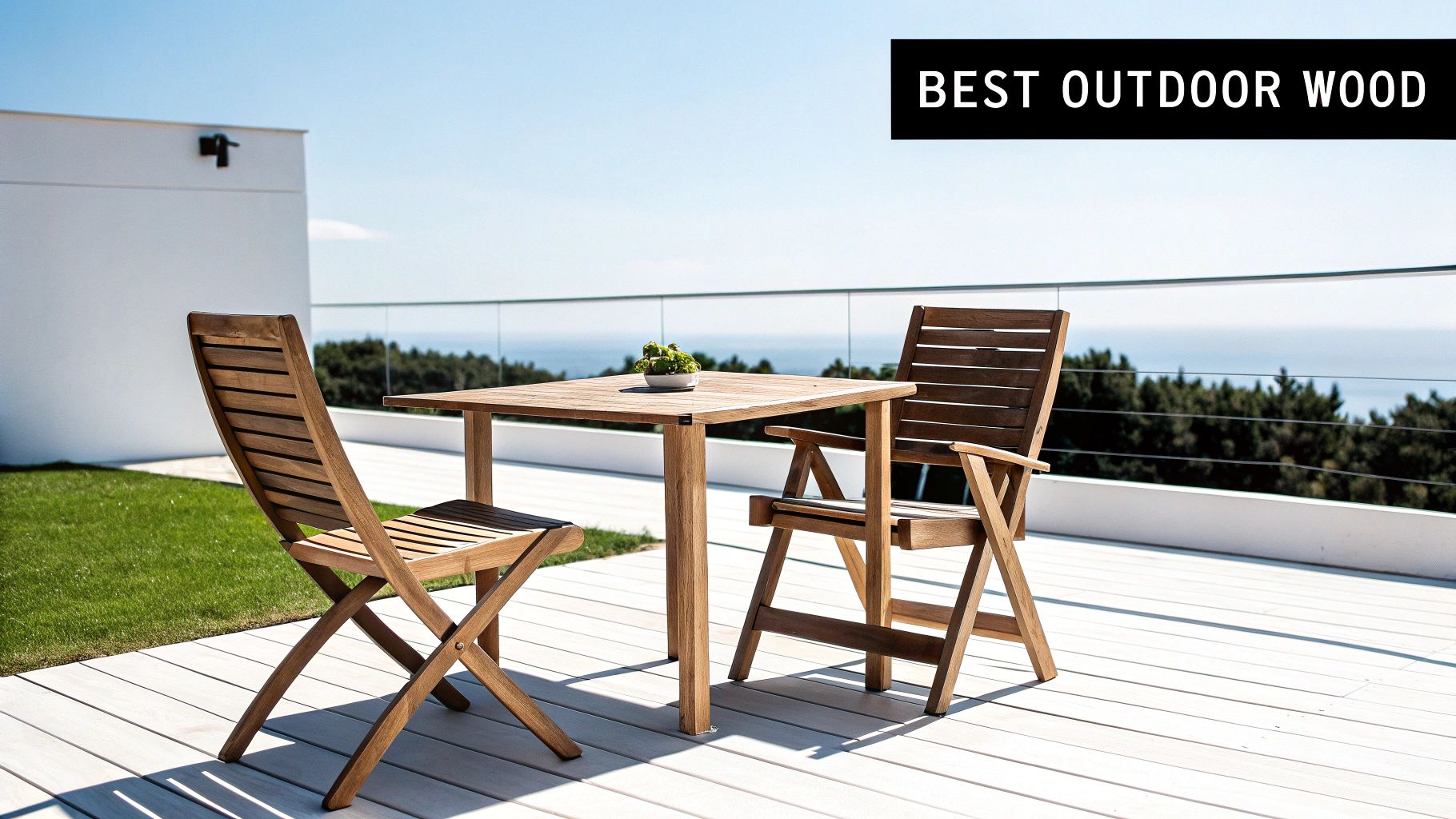
Before you choose a species, it helps to understand what you're actually evaluating. Outdoor performance comes down to three core properties — and a high Janka hardness rating isn't one of them.
The best outdoor woods produce natural oils, resins, and tannins inside their fibres. These compounds actively repel moisture, fungi, and insects — think of them as a built-in preservative that no surface finish can fully replicate. Species like White Oak, Afromosia, and Merbau produce these compounds in abundance. Species like Poplar or Birch produce almost none, which is why they belong indoors.
All wood expands and contracts as humidity changes. But some species move far less than others. In Canadian and northern US climates — where you might swing from a wet spring to a dry summer — dimensional stability is critical. Unstable wood types will warp, crack, and pull joints apart. Stable wood stays flat and tight year after year.
This one is underrated. Woods with a closed-grain structure (like White Oak) have naturally plugged pores that block water from soaking deep into the wood. Woods with an open-grain structure (like Red Oak) act like a sponge — moisture wicks straight in and rot follows. This single characteristic explains why White Oak has been used for shipbuilding and barrel-making for centuries, while Red Oak is kept strictly indoors.
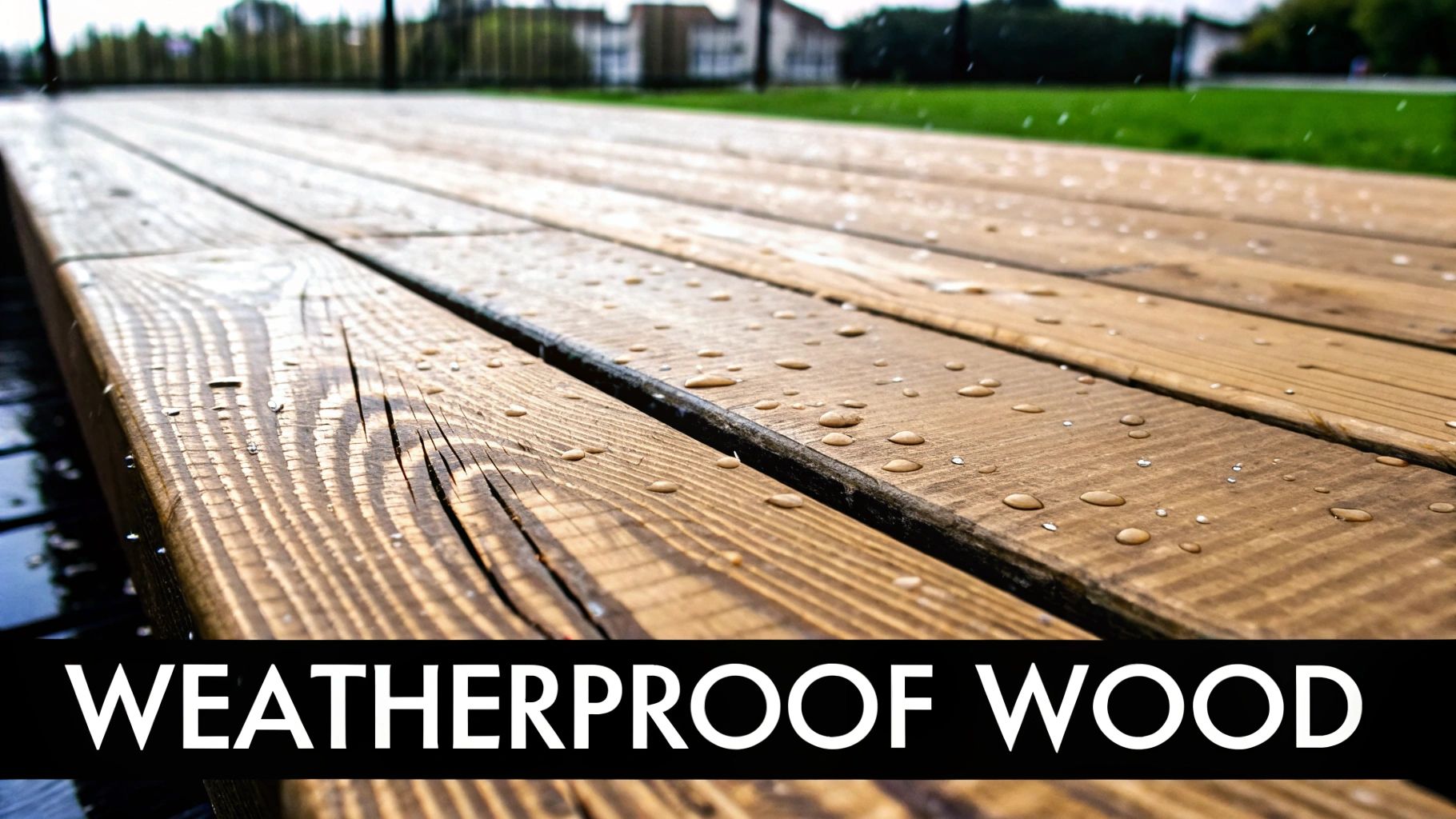
Here's an honest breakdown of the outdoor-suitable species we carry, with real performance notes for each one.
Industry-standard durability class ratings for every species we carry. Lower class = better natural outdoor resistance without treatment. Hover any bar for details.
How to read this chart: Durability class is the industry standard for natural outdoor resistance without chemical treatment. Lower class = longer outdoor lifespan. Janka hardness (shown in tooltips) measures dent and wear resistance — both matter for outdoor furniture. A Class 2 species with high Janka, like Merbau or Afromosia, gives you the best of both.

If you want the best hardwood for outdoor furniture without venturing into exotic territory, White Oak is your answer. Its defining characteristic is a naturally closed-grain structure packed with tyloses — microscopic cellular plugs that physically block water from penetrating the wood. This is the same reason White Oak was the timber of choice for centuries of shipbuilding, wine barrel production, and exterior millwork.
White Oak is dense, hard (1,360 lbf Janka), and loaded with tannins that actively fight rot and insects. It's dimensionally stable across seasonal humidity swings, meaning a wide outdoor tabletop won't dramatically warp or cup from spring to summer. Aesthetically, it's stunning — a warm golden-brown with a distinctive ray-fleck figure, especially pronounced in quarter-sawn boards.
We carry both flat-sawn and quarter-sawn White Oak. For outdoor furniture specifically, quarter-sawn is the stronger choice — the vertical grain orientation makes it even more dimensionally stable and water-resistant than flat-sawn, and the ray-fleck figure looks exceptional under an oil finish.
Best for: Outdoor dining tables, heavy benches, garden chairs, any furniture that needs to hold its shape across four seasons.
| Property | Rating |
|---|---|
| Weather resistance | Excellent |
| Dimensional stability | Very good |
| Workability | Good |
| Maintenance required | Moderate — annual oiling or sealing |
| Cost | Mid-to-high |
Shop White Oak lumber at Knotty Lumber →
Afromosia (Pericopsis elata) is one of the most underrated outdoor hardwoods available in North America. It's commonly called "African teak" — not because it's in the same botanical family, but because it performs almost identically outdoors. High natural oil content, exceptional rot and insect resistance, excellent dimensional stability, and a Janka rating of around 1,560 lbf. It checks every box that teak checks, often at a more accessible price point.
Visually, Afromosia is a warm golden-yellow to medium brown, with an interlocked grain that gives it a subtle lustre. It machines cleanly, holds screws well, and takes an oil finish beautifully. If you've been priced out of teak or can't source it responsibly, Afromosia is the legitimate replacement that experienced woodworkers in Europe have relied on for decades.
Best for: Premium patio sets, poolside loungers, any project where you'd normally reach for teak.
| Property | Rating |
|---|---|
| Weather resistance | Excellent |
| Dimensional stability | Excellent |
| Workability | Very good |
| Maintenance required | Very low — occasional oiling |
| Cost | Mid-to-high |
Shop Afromosia lumber at Knotty Lumber →
Merbau (Intsia bijuga) is a dense, heavy tropical hardwood with a long track record in outdoor and marine applications across Southeast Asia and Australia. With a Janka rating of around 1,925 lbf and high concentrations of natural oils and silica, it resists rot, insects, and moisture with almost no chemical assistance required.
One quirk worth knowing upfront: Merbau contains water-soluble extractives that can bleed a reddish-brown tint when first exposed to rain. This is temporary — it stops after a few wet cycles — but worth sealing any surrounding concrete or stone until the initial bleed-out is finished. Past that breaking-in period, it's extremely low-maintenance and builds a beautiful rich reddish-brown patina over time.
Best for: Heavy permanent furniture, outdoor benches, pieces in high-moisture environments like poolside or covered decks.
| Property | Rating |
|---|---|
| Weather resistance | Excellent |
| Dimensional stability | Very good |
| Workability | Moderate — sharp tooling required |
| Maintenance required | Low |
| Cost | Mid-to-high |
Shop Merbau lumber at Knotty Lumber →
African Padauk (Pterocarpus soyauxii) is the single most durable species in our inventory by outdoor classification — a Class 1 hardwood, putting it in the same tier as legendary outdoor woods like Ipe and Teak. That Class 1 rating means exceptional natural resistance to rot, fungi, and insects with a documented lifespan of 25+ years outdoors without chemical treatment.
Most woodworkers don't know about Padauk is that its outdoor credentials are as strong as its visual ones. It carries a very high concentration of natural extractives and resins that actively protect it from the elements. With a Janka rating of 1,720 lbf it's also genuinely hard — resistant to denting, wear, and the daily abuse outdoor furniture takes.
Visually, fresh Padauk is a striking vivid orange-red that deepens and mellows to a rich reddish-brown over time, especially with UV exposure. That colour shift is part of its character. Left unfinished outdoors it develops a warm patina; oiled regularly it holds its deeper tones beautifully. The one practical consideration: Padauk's natural extractives can bleed a reddish tint when first wet, similar to Merbau. Protect surrounding surfaces until the initial bleed-out cycle is complete.
Best for: Premium outdoor furniture, statement pieces, poolside and high-exposure applications where you want Class 1 durability with exceptional visual impact.
| Property | Rating |
|---|---|
| Weather resistance | Exceptional — Class 1 |
| Dimensional stability | Very good |
| Workability | Good — machines well, pre-drill for fasteners |
| Maintenance required | Very low — occasional oiling optional |
| Cost | Mid-to-high |
Shop Padauk lumber at Knotty Lumber →
Wenge (Millettia laurentii) is a striking Central African hardwood best known for its dramatic near-black colouring with fine pale grain lines running through it — one of the most visually distinctive species available anywhere. What's less widely known is that it carries a Class 1 durability rating, making it one of the most durable outdoor hardwoods available.
At 1,950 lbf Janka, Wenge is hard and dense, with natural resins and extractives that give it solid resistance to rot, decay, and insects. It's dimensionally stable and holds up well across seasonal humidity changes. The tradeoff is workability — Wenge is coarse-grained, prone to splintering along the grain, and needs sharp tooling and pre-drilling for fasteners. It also raises very fine, sharp splinters during machining, so proper dust protection and careful sanding are essential.
Finished with a penetrating oil, Wenge's deep chocolate-black tones become even richer. It's a statement species — best suited to projects where the visual impact is as important as the outdoor performance.
Best for: Statement outdoor pieces, modern patio furniture, accent tables, and sheltered or semi-exposed builds where the dramatic colouring is the design centrepiece.
| Property | Rating |
|---|---|
| Weather resistance | Very good — Class 2 |
| Dimensional stability | Good |
| Workability | Challenging — sharp tooling, pre-drill required |
| Maintenance required | Low — annual oiling recommended |
| Cost | High |
Shop Wenge lumber at Knotty Lumber →
Purpleheart (Peltogyne spp.) is a South American hardwood that earns its name — freshly cut boards are a vivid, intense violet-purple that gradually deepens to a rich eggplant-brown with UV exposure. But beyond the colour, Purpleheart has genuine outdoor credentials that don't get nearly enough attention. It carries a Class 1 durability rating, outperforming White Oak and Black Walnut outdoors, but with considerably more hardness at 2,520 lbf Janka — one of the densest species we carry.
That density is key to its outdoor performance. Purpleheart's tight, interlocked grain and high natural extractive content give it solid resistance to rot, fungi, and insects. It's dimensionally stable and handles moisture well for a tropical hardwood in its class. The workability tradeoff is real — its density means it's hard on tooling and requires sharp blades and pre-drilling for fasteners — but the results are extraordinary.
One thing to know: UV exposure will shift Purpleheart's colour from vivid purple toward brown relatively quickly outdoors. If maintaining the purple tone matters, a UV-blocking oil finish applied regularly will slow the transition significantly. Many woodworkers embrace the colour shift as part of the wood's natural character.
Best for: Statement outdoor furniture, accent pieces, mixed-species builds where the colour contrast is a design feature, covered patio applications where UV exposure is reduced.
| Property | Rating |
|---|---|
| Weather resistance | Good — Class 1 |
| Dimensional stability | Good |
| Workability | Moderate — dense, pre-drill required |
| Maintenance required | Moderate — UV-blocking oil preserves colour |
| Cost | Mid-to-high |
Shop Purpleheart lumber at Knotty Lumber →
Western Red Cedar (Thuja plicata) is one of the most trusted outdoor woods in North America. It punches far above its weight class for a softwood. The secret is a high concentration of natural thujaplicins — aromatic compounds that give it its distinctive smell and are highly toxic to the fungi and insects that cause rot. This gives Western Red Cedar genuine outdoor durability without the density of a hardwood.
It's exceptionally light, which makes it the go-to choice for furniture you'll actually move: Adirondack chairs, planters, porch swings, and garden benches that follow the sun around the yard. It's also a dream to work with — cuts cleanly, sands smoothly, and holds paint or stain well. The tradeoff is softness (Janka 350 lbf), meaning it dents more easily than hardwood alternatives and benefits from consistent finishing to maintain its colour and prevent surface greying.
Best for: Adirondack chairs, porch furniture, planter boxes, movable garden seating, DIY-friendly builds with curves and angles.
| Property | Rating |
|---|---|
| Weather resistance | Very good |
| Dimensional stability | Good |
| Workability | Excellent — highly DIY-friendly |
| Maintenance required | Moderate — seal or stain every 1–2 years |
| Cost | Mid-range |
Shop Western Red Cedar lumber at Knotty Lumber →
Eastern Red Cedar (Juniperus virginiana) — commonly known as Aromatic Cedar — is a distinctly different species from Western Red Cedar, and it brings its own strengths to outdoor projects. It's the wood most associated with cedar chests and closet liners, but its outdoor credentials are real.
Eastern Red Cedar produces a high concentration of aromatic oils that are naturally insect-repellent (particularly effective against moths) and provides solid resistance to rot and decay. It's denser than Western Red Cedar and has a dramatically beautiful heartwood: deep reddish-purple tones streaked with creamy white sapwood. That colour contrast makes it a standout for decorative outdoor pieces where character and visual interest matter as much as durability.
It is knotty by nature which some woodworkers love and others find challenging to work around. The grain can be irregular and the wood is more brittle than Western Red Cedar, making it better suited to smaller accent pieces than large structural builds.
Best for: Decorative garden furniture, small benches, rustic accent pieces, projects where the dramatic colour variation is a design feature.
| Property | Rating |
|---|---|
| Weather resistance | Good |
| Dimensional stability | Moderate |
| Workability | Moderate — irregular grain, brittle |
| Maintenance required | Moderate — sealing preserves colour |
| Cost | Mid-range |
Shop Aromatic Cedar lumber at Knotty Lumber →
Black Walnut deserves an honest mention here because it's one of the most desired domestic hardwoods and everyone at one time or another will ask about using it outdoors. The short answer: it can work, with caveats.
Black Walnut contains juglone and other natural compounds that give it moderate natural decay resistance — enough for a Class 3 durability rating — a moderate outdoor performer compared to Class 1 species like White Oak, Afromosia, and Padauk. It's been used historically for fence posts and outdoor applications. However, it falls well short of Afromosia in sustained outdoor performance, particularly in climates with significant rainfall or wide humidity swings.
Where Black Walnut shines outdoors is in sheltered or semi-exposed applications — a covered patio table, an outdoor bar top under a pergola, or decorative accents on an otherwise weather-resistant frame. In these conditions, properly sealed Walnut performs well and looks absolutely extraordinary. Fully exposed to weather with no maintenance, it will degrade faster than the other species on this list.
Best for: Covered patio tabletops, outdoor bar tops, semi-sheltered furniture with regular maintenance. Not recommended for fully exposed, low-maintenance outdoor use.
Shop Black Walnut lumber at Knotty Lumber →
| Species | Weather Resistance | Durability Class | Stability | Janka (lbf) | Maintenance | Cost | Best Use Case |
|---|---|---|---|---|---|---|---|
| Padauk | Exceptional | Class 1 | Very good | 1,725 | Very low | $$$ | Premium furniture, poolside, high-exposure builds |
| Afromosia | Excellent | Class 1 | Excellent | 1,560 | Very low | $$$ | Premium patio sets, poolside |
| Merbau | Excellent | Class 1 | Very good | 1,925 | Low | $$$ | Heavy permanent pieces, wet environments |
| Wenge | Very good | Class 1 | Good | 1,950 | Low | $$$$ | Statement pieces, modern outdoor furniture |
| W. Red Cedar | Very good | Class 2 | Good | 350 | Moderate | $$ | Adirondack chairs, planters, DIY builds |
| Aromatic Cedar | Good | Class 2 | Moderate | 900 | Moderate | $$ | Decorative pieces, rustic accent furniture |
| White Oak (qs) | Very good | Class 1 | Very good | 1,360 | Moderate | $$$ | Tables, benches, permanent furniture |
| Purpleheart | Good | Class 1 | Good | 2,520 | Moderate | $$$ | Statement pieces, covered patio builds |
| Black Walnut | Moderate | Class 3 | Good | 1,010 | High | $$$ | Covered/sheltered outdoor applications only |
The best wood for outdoor furniture depends entirely on what you're building and where it's going to live. Here's how to think about it by project type.
For big, stationary pieces, prioritize dimensional stability and density above everything else. A wide tabletop that cups or warps is a failure regardless of how beautiful the species is. Quarter-sawn White Oak is the top domestic choice — vertical grain minimizes movement and the closed-grain structure handles moisture exceptionally well. Afromosia and Merbau are both outstanding if you want a tropical hardwood with even lower maintenance requirements. For a true statement dining table that will last a lifetime, Padauk combines Class 1 durability with a colour and figure that will stop people in their tracks.
Weight is the primary constraint for anything you'll be moving around. A heavy hardwood chair stops being moved after about the second time you try. Western Red Cedar is the clear winner here — genuinely light, easy to cut and shape, and naturally rot-resistant enough for full outdoor exposure. Its soft texture also makes it forgiving to work with for the compound angles and curves a classic Adirondack demands.
Soil contact is brutal on wood. The constant moisture and microbial activity accelerate decay faster than almost any other outdoor environment. For planters, you want a naturally rot-resistant species and ideally a liner between the wood and soil. Western Red Cedar is the traditional choice and holds up genuinely well. White Oak is also an excellent option and will outlast Cedar in direct soil contact. For the most demanding planter applications, Padauk or Afromosia — both Class 1 — will outlast almost anything else available. For either species, seal interior surfaces and avoid direct soil contact wherever possible.
Poolside furniture faces the most demanding outdoor conditions: constant moisture, UV exposure, chlorine splash, and often no overhead shelter. This is where you want maximum natural oil content and density. Padauk at Class 1 is the top performer here — the same tier as Ipe and Teak, with the added visual impact of its deep reddish tones. Afromosia is equally strong and somewhat easier to work with. Merbau is another excellent choice given its density and silica content. All three can be left unfinished to develop a natural silver-grey patina, or oiled periodically to maintain their original colour.
Sheltered outdoor furniture operates in a middle ground — exposed to humidity and temperature swings but protected from direct rain and UV. This opens the door to a wider species selection. Black Walnut becomes a viable and spectacular choice here. A properly sealed Walnut dining table under a covered pergola will hold up well and look extraordinary for years. Purpleheart is another outstanding option for covered applications — its UV sensitivity is less of a concern under a pergola, so you can enjoy the vivid purple tones for much longer. White Oak and Aromatic Cedar are also excellent options for this category. Wenge's dramatic dark colouring pairs beautifully with modern pergola aesthetics and benefits from the reduced UV exposure.
Not every outdoor build is purely functional. If the visual impact of the species is as important as its performance, you have strong options across the durability spectrum. Padauk's vivid orange-red, Purpleheart's striking violet, and Wenge's near-black drama each offer a visual character that painted or synthetic furniture simply cannot match. All three carry Class 1 durability ratings, meaning the beauty isn't a compromise — these are genuinely capable outdoor species that also happen to look extraordinary.
People's love for authentic materials is as strong as ever. In the United States outdoor furniture market, wood holds a massive 46% market share, proving its lasting popularity for both its beauty and its performance.

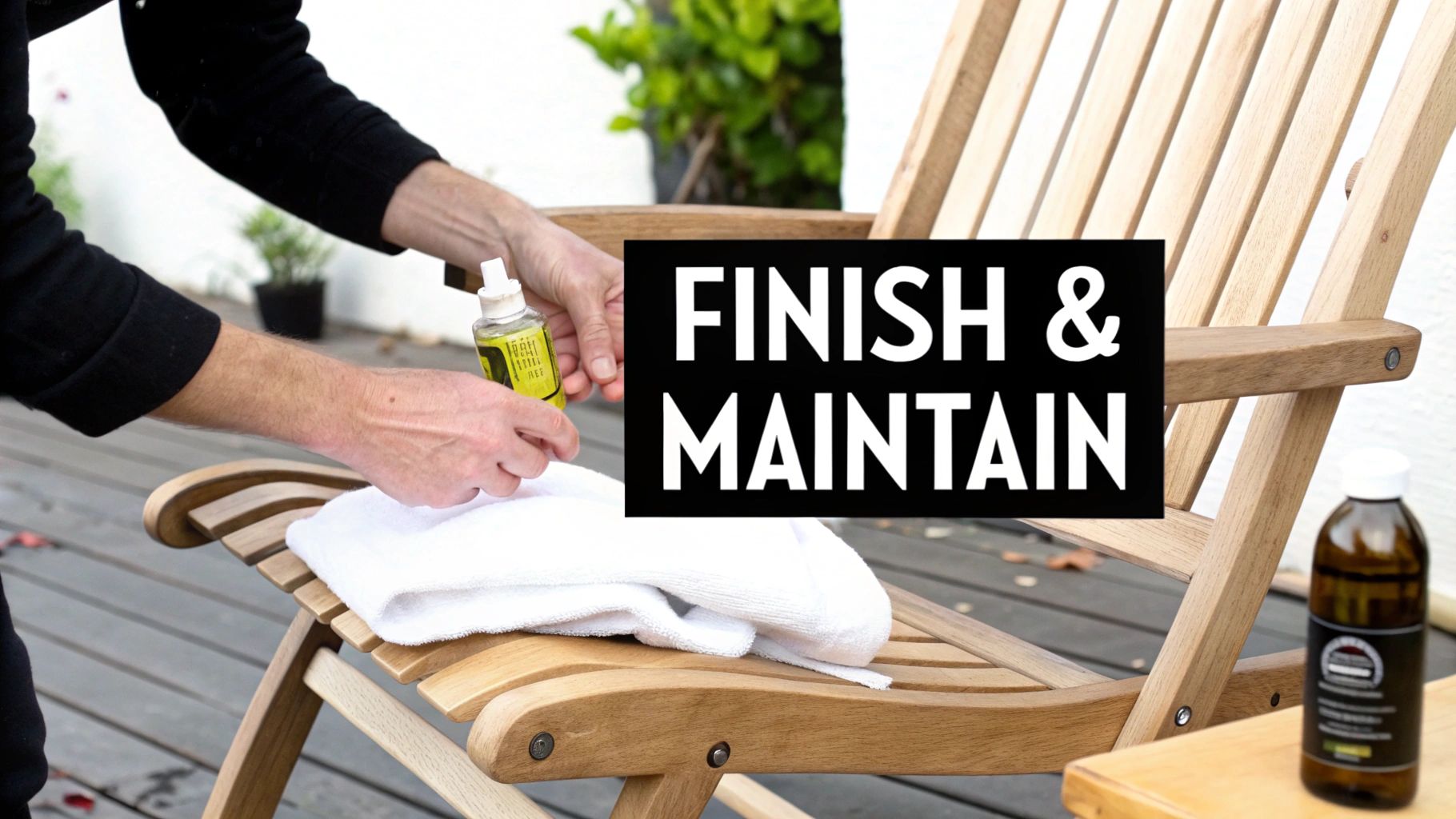
Choosing the right wood is half the job. How you finish and maintain it determines whether that wood reaches its potential. Here's what you need to know about the main finishing approaches for outdoor wood furniture.
Penetrating oils — tung oil, danish oil, teak oil — soak into the wood fibres rather than sitting on the surface. They enhance the natural grain, provide moisture resistance from within, and leave a matte, tactile finish that feels like real wood. These are the ideal finish for dense, naturally oily species like Padauk, Afromosia, and Merbau, because they work with the wood's existing chemistry rather than against it.
The major advantage of oil finishes is how easy they are to maintain. When the wood starts looking dry — typically once a year — clean the surface and wipe on a fresh coat. No stripping, no peeling, no starting over.
Film finishes create a protective shell on the surface of the wood rather than penetrating it. Spar urethane is formulated specifically for outdoor use — it's flexible enough to move with the wood as it expands and contracts, and provides strong UV protection. This makes it a good choice for species like Western Red Cedar that benefit from the added surface barrier, and for colour-sensitive species like Purpleheart where slowing UV-driven colour shift matters.
The tradeoff is maintenance complexity. Once a film finish fails — through a scratch, a crack, or age — moisture gets underneath and the finish peels or bubbles. Repair means sanding back to bare wood and starting over. For furniture that's going to take serious daily use and abuse, this is worth factoring into your finishing decision.
For high-oil tropical hardwoods like Padauk, Afromosia, and Merbau, there's a third entirely valid approach: do nothing. Left unfinished, these species slowly weather from their original vibrant tones to an elegant silver-grey patina. This colour change is purely surface-level — the wood's structural integrity and rot resistance are completely unaffected. It's the lowest-maintenance outdoor finish possible, and a look that many woodworkers actively prefer. An occasional scrub with mild soap and water is all the upkeep it needs.
For a more in depth look into finishing techniques, check out mastering wood finishing techniques
No matter which species or finish you choose, a simple maintenance routine dramatically extends the life of outdoor furniture.
For most woodworkers and most applications, quarter-sawn White Oak is the best all-around domestic choice — proven outdoor performance, excellent dimensional stability, and natural rot resistance built into its closed-grain structure. For premium applications with the lowest possible maintenance requirements, Afromosia is the top pick. And if you want the absolute best outdoor durability we carry, Padauk at Class 1 is in a tier of its own.
Padauk is the most durable species we carry — a Class 1 hardwood with a documented outdoor lifespan of 25+ years without treatment. Afromosia and Merbau both share that Class 1 rating, making all three outstanding performers that comfortably outlast most domestic alternatives.
Yes — both Cedar species we carry are genuinely suited for outdoor use, but they perform differently. Western Red Cedar is the stronger outdoor performer, with higher natural oil content and a Class 2 durability rating. It's one of the best options for lightweight, movable outdoor furniture. Aromatic Cedar (Eastern Red Cedar) is also outdoor-suitable and brings beautiful colour variation and strong insect resistance, but is better suited to smaller decorative pieces than large structural builds.
The most effective approach combines species selection with proper finishing. Start with a naturally resistant species — Padauk, Afromosia, Merbau, White Oak, or Cedar. Then apply either a penetrating oil finish annually, or a film-forming exterior finish like spar urethane for stronger surface protection. For the highest-oil tropical species, you can also leave the wood unfinished and allow it to develop a natural patina — a low-maintenance option that doesn't compromise the wood's structural performance.
No — and this is one of the most common and costly mistakes in outdoor woodworking. Red Oak has an open-grain structure with pores that wick moisture directly into the wood. It carries a Class 4 durability rating and will degrade quickly in any outdoor exposure. Always use White Oak for outdoor projects. They look similar in a store, but perform completely differently once they're outside.
For dense, naturally oily species like Padauk, Afromosia, and Merbau, a penetrating tung or teak oil applied annually is ideal — it works with the wood's natural chemistry and is straightforward to maintain. For less oily species like White Oak and Cedar, a quality exterior spar urethane provides stronger surface protection, especially in high-UV or high-rain environments. For colour-sensitive species like Purpleheart, a UV-blocking oil or varnish will significantly slow the natural colour shift that occurs with sun exposure.
Look for third-party certifications — the Forest Stewardship Council (FSC) is the most recognized global standard, ensuring wood comes from responsibly managed forests. In North America, the Sustainable Forestry Initiative (SFI) is another credible certification. For tropical species especially, don't hesitate to ask your supplier directly about sourcing. A reputable dealer will be transparent about chain of custody and able to provide documentation. At Knotty Lumber, we're happy to answer sourcing questions on any species we carry.
Every species covered in this guide is available in our online store, milled to consistent 4/4 thickness and ready for your project. Whether you're building a quarter-sawn White Oak dining table, a Western Red Cedar Adirondack chair, a striking Padauk poolside lounger, or a Purpleheart accent bench for a covered patio, we carry the lumber to make it happen.
Browse our full hardwood collection →
Questions about which species is right for your specific project? We're woodworkers too — reach out and we'll give you a straight answer.


